
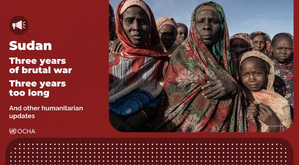
Millions of lives have been torn apart in front of the world's eyes. Today, nearly 34 million people – more than two-thirds of the population – need humanitarian support. Sudan is also the world’s largest displacement crisis.
"We need action now – to stop the violence, protect civilians, ensure access to communities in greatest danger, and fund the response." - Tom Fletcher, UN Relief Chief
Read the UN Relief Chief’s full statement.
Speaking at the International Humanitarian Conference for Sudan in Berlin on Wednesday, Tom Fletcher described Sudan as “an atrocities laboratory,” pointing to the siege of communities, the denial of food, the use of sexual violence as a weapon of war, and attacks on schools and hospitals.
He said drone strikes have killed 700 people so far this year, while more than 130 humanitarian workers have been killed over the past three years. Watch his video:
Humanitarian Coordinator Denise Brown also underscored the unbearable toll on civilians, who continue to pay the highest price. Read her statement.
"Everywhere I have travelled across Sudan, people talk about peace. They want the violence to stop and to return home. Their resilience is extraordinary."
Watch her press briefing. 👇
Here are 5 things the world must not ignore about Sudan’s crisis. 👇
To mark this grim anniversary, we are also sharing the stories of survivors from Darfur: Shadia, Hamza, Elhadi, Zakia and Maha. Their lives have been shattered by the war. They survived horrific violence and abuses that may amount to war crimes.
Read what they told photographer Giles Clarke in February 2026 about surviving Sudan’s war.

This week, we also shared the voices of OCHA staff who continue to serve people in need across Sudan while separated from their families for long periods. Ghada Nsreldeen, Mohammed Gimish and Nasir Abdalla reflect on what keeps them going – and how helping others gives them strength.
Civilians and civilian infrastructure must be protected in line with international humanitarian law. The parties to the conflict must facilitate safe, rapid, unimpeded and sustained humanitarian access.
The response within Sudan and in neighbouring countries must be urgently and fully funded. Every delay costs lives.
This senseless war must end now.
Donate to help families in Sudan.
Lebanon: Escalating violence drives displacement and strains aid response
Humanitarian needs are rapidly worsening in Lebanon as high-intensity hostilities continue to take a heavy toll on civilians.
More than 40 people were killed and over 160 injured in the past day alone, bringing total casualties since early March to over 2,100 dead and 7,000 injured since the start of the escalation on March 2nd, according to authorities. Displacement has surged, with more than 1.2 million people forced from their homes.
Ongoing fighting and damage to key infrastructure – including the Qasmiyeh bridge – are restricting movement and cutting off access to southern areas, leaving tens of thousands increasingly isolated.
Attacks on healthcare are also rising, with facilities damaged and health workers killed or injured, further limiting access to critical care. Since the escalation, attacks on healthcare have resulted in 88 deaths and more than 200 injuries among health workers. These incidents constitute a serious violation of international humanitarian law and are severely undermining people’s access to healthcare.
Despite these challenges, humanitarian partners continue to deliver essential support, including water, shelter items and hygiene supplies. However, severe underfunding is putting the response at risk, with the Lebanon Flash Appeal still largely unmet as needs continue to grow.
Read the daily updates.

Voices from the ground
“We all just want this to end,” says Sahara, who fled her home with her husband and two sons during early morning airstrikes. Like many others, they sought refuge in a school-turned-shelter in Beirut, relying on support from local organizations for basic items such as mattresses, blankets and lighting.
Her story reflects the reality for millions across Lebanon – families forced to flee overnight, seeking safety while hoping for an end to the violence.
Listen to her story and read more:
Emergency funding released to support crisis response in Iran
The Emergency Relief Coordinator, Tom Fletcher, allocated $12 million from the UN's Global Emergency Response Fund CERF to scale up life-saving humanitarian assistance in Iran.
According to authorities, between 28 February and 8 April, large-scale airstrikes across the country caused over 2,300 civilian deaths and widespread destruction of homes, health facilities and critical infrastructure, severely disrupting access to essential services.
Although the ceasefire has eased insecurity, widespread destruction, rubble, and explosive or toxic remnants of war continue to prevent people from accessing basic services and hinder rescue and response efforts.
The funding will support urgent needs in health care, water, sanitation and food assistance, with a focus on the hardest-hit areas and displaced communities. Where possible, response activities will be implemented through local partners, aligned with large-scale efforts led by the Government.

Yemen: Needs rising, humanitarian efforts under strain
In Yemen, a decade of conflict has left millions hanging by a thread and the crisis is deepening. More than 22 million people need humanitarian aid, with over 18 million facing severe hunger. Families are skipping meals, children are acutely malnourished and a collapsing health system is leaving millions without care as diseases spread.
Briefing the UN Security Council, Edem Wosornu, Director of OCHA’s Crisis Response Division warned that access constraints and funding gaps are undermining the humanitarian response. The humanitarian community plans to reach 12 million people this year – but without urgent support and unimpeded access, needs will continue to outpace aid.

Read more.
A time of inequality. A time of lawlessness. A time of division. This is a time for the United Nations.
In his remarks at the UN Foundation’s We the Peoples 2026 event, Tom Fletcher underscored the urgency of collective action as global crises intensify. With humanitarian needs rising and aid workers operating under growing risk, he called for stronger solidarity, increased funding and broader partnerships to reach 87 million people with life-saving support this year – reminding that while no one can solve every crisis, together, we can change lives.
More humanitarian updates & interesting reads to explore
- This week in humanitarian action – watch the video
- Severe drought is pushing people in Somalia deeper into crisis.
- 5.7 million people are facing hunger in Haiti. This crisis is deepening. We must not look away. More from OCHA's Director of Crisis Response Division, Edem Wosornu's visit.
- After years of displacement in north-east Nigeria, women and girls still struggle to meet basic needs.
- Mechanical failures threaten essential services in the Occupied Palestinian Territory.
- Funding shortfall imperils aid in the Central African Republic.
- Civilian casualties in Ukraine spike in March.
- Explosive hazards, violence continue to claim lives in Afghanistan.
- UN reiterates support following deadly stampede in Haiti.
For those who haven’t yet, subscribe to our newsletter to receive regular humanitarian updates.
Contribute to the 🔊 Listening Channel to help reimagine what humanitarian action must look like in today’s world – a space for open dialogue, bold thinking and constructive challenge.
Like, share, comment, and look out for the next upcoming editions. Thank you for the continued support.
For more, follow our social media channels X | IG | FB | LI | Bluesky | TikTok
